🚚 Free Worldwide Shipping on All Orders!Shop Now

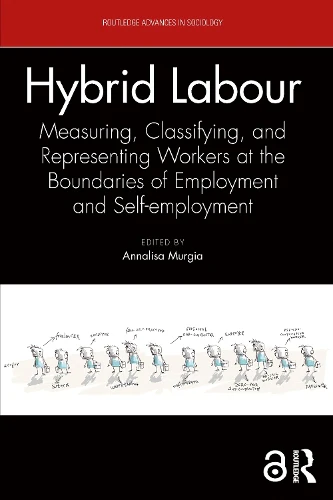
Hybrid Labour
This book advances the debate on the hybrid areas of labour by taking the case of work arrangements that destabilise the dichotomies between standard and non‑standard work and between self‑employment and dependent employment. By maintaining the connection between structural conditions and human agency, it focuses not only on how workers at the boundaries between employment and self‑employment are affected by social norms and institutions but also on how they can shape them in turn, especially through collective organising. The analysis presents the main findings of the ERC project SHARE – Seizing the Hybrid Areas of work by Representing self‑Employment – a six‑year transdisciplinary and multi‑method study conducted by combining comparative analysis of labour laws and labour force surveys with a cross‑national ethnography carried out in six European countries: Germany, France, Italy, Slovakia, the Netherlands, and the United Kingdom. By proposing to use ‘Hybrid as Method’, the tensions between employment and self‑employment are analysed to challenge the hierarchy encoded in this dichotomy and to problematise its boundaries. Indeed, the category of hybrid has proved promising not only for understanding which categories are at stake but also how they have been historically constructed and how they may be differently imagined and conceptualised. This book will be of interest to students and scholars of all social sciences, particularly those who study the ongoing processes of individualisation and the novel forms of organising developed in the hybrid areas of labour. It will also be useful to activists and trade unionists, as well as policymakers. The Open Access version of this book, available at www.taylorfrancis.com, has been made available under a Creative Commons Attribution (CC-BY) 4.0 International license.
$27.79
Original: $79.39
-65%Hybrid Labour—
$79.39
$27.79Product Information
Product Information
Shipping & Returns
Shipping & Returns
Description
This book advances the debate on the hybrid areas of labour by taking the case of work arrangements that destabilise the dichotomies between standard and non‑standard work and between self‑employment and dependent employment. By maintaining the connection between structural conditions and human agency, it focuses not only on how workers at the boundaries between employment and self‑employment are affected by social norms and institutions but also on how they can shape them in turn, especially through collective organising. The analysis presents the main findings of the ERC project SHARE – Seizing the Hybrid Areas of work by Representing self‑Employment – a six‑year transdisciplinary and multi‑method study conducted by combining comparative analysis of labour laws and labour force surveys with a cross‑national ethnography carried out in six European countries: Germany, France, Italy, Slovakia, the Netherlands, and the United Kingdom. By proposing to use ‘Hybrid as Method’, the tensions between employment and self‑employment are analysed to challenge the hierarchy encoded in this dichotomy and to problematise its boundaries. Indeed, the category of hybrid has proved promising not only for understanding which categories are at stake but also how they have been historically constructed and how they may be differently imagined and conceptualised. This book will be of interest to students and scholars of all social sciences, particularly those who study the ongoing processes of individualisation and the novel forms of organising developed in the hybrid areas of labour. It will also be useful to activists and trade unionists, as well as policymakers. The Open Access version of this book, available at www.taylorfrancis.com, has been made available under a Creative Commons Attribution (CC-BY) 4.0 International license.