🚚 Free Worldwide Shipping on All Orders!Shop Now

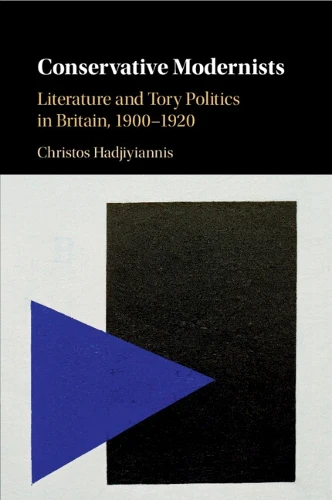
Conservative Modernists
Despite sustained scholarly interest in the politics of modernism, astonishingly little attention has been paid to its relationship to Conservatism. Yet modernist writing was imbricated with Tory rhetoric and ideology from when it emerged in the Edwardian era. By investigating the many intersections between Anglophone modernism and Tory politics, Conservative Modernists offers new ways to read major figures such as T. S. Eliot, Ezra Pound, T. E. Hulme, and Ford Madox Ford. It also highlights the contribution to modernism of lesser-known writers, including Edward Storer, J. M. Kennedy, and A. M. Ludovici. These are the figures to whom it most frequently returns, but, cutting through disciplinary delineations, the book simultaneously reveals the inputs to modernism of a broad range of political writers, philosophers, art historians, and crowd psychologists: from Pascal, Burke, and Disraeli, to Nietzsche, Le Bon, Wallas, Worringer, Ribot, Bergson, and Scheler.
Select Location
Select Condition
Select Location Type
From $46.39
Conservative Modernists—
$46.39
Product Information
Product Information
Shipping & Returns
Shipping & Returns
Description
Despite sustained scholarly interest in the politics of modernism, astonishingly little attention has been paid to its relationship to Conservatism. Yet modernist writing was imbricated with Tory rhetoric and ideology from when it emerged in the Edwardian era. By investigating the many intersections between Anglophone modernism and Tory politics, Conservative Modernists offers new ways to read major figures such as T. S. Eliot, Ezra Pound, T. E. Hulme, and Ford Madox Ford. It also highlights the contribution to modernism of lesser-known writers, including Edward Storer, J. M. Kennedy, and A. M. Ludovici. These are the figures to whom it most frequently returns, but, cutting through disciplinary delineations, the book simultaneously reveals the inputs to modernism of a broad range of political writers, philosophers, art historians, and crowd psychologists: from Pascal, Burke, and Disraeli, to Nietzsche, Le Bon, Wallas, Worringer, Ribot, Bergson, and Scheler.